
 vs
vs

Hale vs High Tech Pet
High Tech Pet's Power Pet door is a motorized appliance that opens for a collar your pet wears. Hale builds the opposite: a custom-fit mechanical door with nothing to charge, program, or brick. For most homes, the simpler door is the smarter buy.
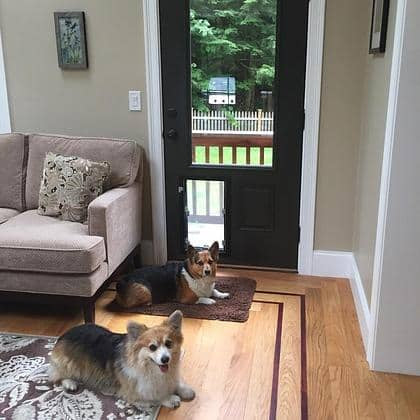 A real Hale Door Model install
The short answer
Which one is right for you?
These aren't the same product. High Tech Pet sells an electronic access system; Hale sells a custom mechanical door. The right pick comes down to one question.

Choose Hale if…
You want a durable door that fits your pet and just works, every day.
- You don't want your pet wearing a transmitter collar, or buying its batteries forever
- You want fewer things that can fail while you're away, no motor, board, sensor, or Wi-Fi
- You need a screen, in-glass, French door, or kennel install High Tech Pet doesn't build
- You want a precise custom fit, a lower starting price, and a lifetime frame warranty
Choose High Tech Pet if…
You specifically need powered, collar-controlled access.
- The door must open only for your pet's collar, to keep raccoons or strays out automatically
- One pet is allowed outside and another isn't
- Your pet flatly refuses to push any flap, and you want a motor to do the work
- You want app timers, remote lock, or activity notifications on your phone
It comes down to one question: do you actually need a motor and a collar, or just a door that fits and works? The rest of this page answers it.
The real difference
A powered appliance vs. a custom mechanical door
This is the whole decision. A motorized door earns its keep in a few specific homes. For the rest, a simpler door that fits is the better long-term buy. Here's why.
Our design: “fewer parts, longer life”
A custom mechanical door
A flexible PVC flap with magnetic closure, a 6063-T5 extruded aluminum frame, weatherstripping, and a locking security cover, built to order in 11 standard sizes or fully custom. Your pet simply pushes through. Nothing to power.
High Tech Pet's design: “a motor and a collar”
A motorized electronic door
A sensor reads the ultrasonic transmitter collar your pet wears, a motor lifts the panel, and an automatic deadbolt relocks it. The newer Wi-Fi and Roll-Up models add an app. The brand calls it "the most sophisticated appliance your pet will ever own."
The honest framing. High Tech Pet gives you control by adding technology. Hale gives you reliability by removing it. Neither is wrong, they just solve different problems. The question is which problem you actually have.
What keeps a Power Pet door working
14 linksEvery link is something that can drain, glitch, or break. High Tech Pet's own troubleshooting routes common problems to replacement boards, motors, sensor cables, and adapters.
What keeps a Hale door working
5 partsA torn flap is a different class of problem than a dead collar battery or a failed circuit board. You swap a flap and move on, no charger, no app, no firmware to keep current.
In fairness
The narrow cases where High Tech Pet wins
We'll say it plainly: High Tech Pet is the better buy in three specific situations. If one is a hard requirement, buy theirs with confidence. For most homes, none of them applies.
You need collar-controlled access
The Power Pet door stays deadbolted until it senses your pet's collar, so it can keep raccoons, skunks, or strays out automatically, or let one pet through while keeping another in. Hale is mechanical by design and doesn't do selective access.
Your pet won't push any flap
Some timid, elderly, or injured pets refuse to nose through a flap. The Power Pet panel opens upward under motor power, so the pet never pushes anything. For a pet that flatly won't, that's a genuine win.
You want app control
On the Wi-Fi and Roll-Up models you get remote lock, day-of-week timers, activity history, and phone notifications. Hale has no app or Wi-Fi, by design. If you want to lock the door from your phone, that's High Tech Pet's lane.
If any of these is your real reason for buying, the Power Pet door is the right call, and many owners love theirs for exactly this. The rest of the page is for everyone else.
Why Hale wins
Five places Hale comes out ahead
For most people comparing these two, it comes down to these five, starting with the one that matters most.
Nothing to power. Nothing to program. Nothing to brick.
A Power Pet door's job depends on a collar, a battery, a motor, a board, sensors, and on the new models a Wi-Fi link. Any one of them can fail while you're away. That's the regret pattern in their own reviews: great when it works, a project when it doesn't.
A Hale door has no electronics at all. Your pet pushes through a soft flap; the frame is backed for life. There's no charger, no app, and no proprietary battery cycle to manage, for 20 years.
One owner said the door stopped opening after two years and wanted to replace it with something she could “install once” and stop thinking about. , Power Pet review on Chewy
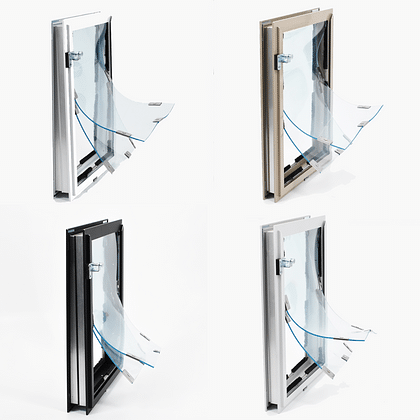 Soft flap · zero electronics
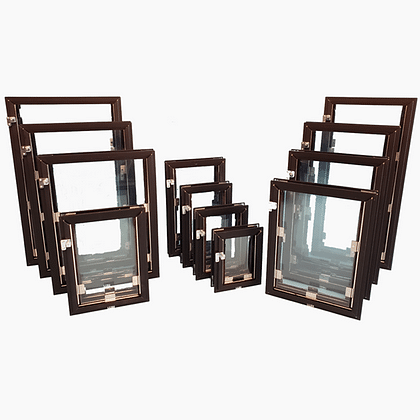 11 standard sizes + custom
The door fits your pet, not the other way around
High Tech Pet's classic line is essentially medium or large; the Roll-Up adds an XL. That's the whole range, and it sizes mostly by weight.
Hale offers 11 standard sizes plus true custom, sized by your pet's shoulder height and chest width, the only way to fit a deep-chested greyhound and a low-slung bulldog that weigh the same. The Roll-Up XL clears a high weight ceiling, but for odd body shapes and opening geometry, Hale is the cleaner fit.
Five install families, including three High Tech Pet doesn't build
High Tech Pet covers door, wall, and patio. Hale covers door, wall, screen, in-glass, French door, and kennel, and a screen porch, a French door, or a commercial kennel simply isn't in the Power Pet catalog.
Our wall model is a purpose-built through-wall product with its own tunnel, framing, and flashing, not a door unit forced into a wall, which is a recurring Power Pet complaint.
One owner's exterior-wall Power Pet install in 2x6 framing was unreliable, and he said the tunnel wasn't deep or sturdy enough. , owner review on ConsumerAffairs
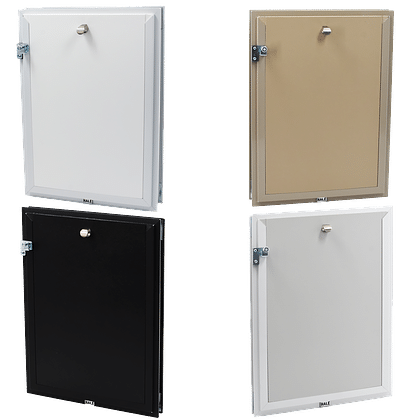 Door · Wall · Screen · In-glass · Kennel
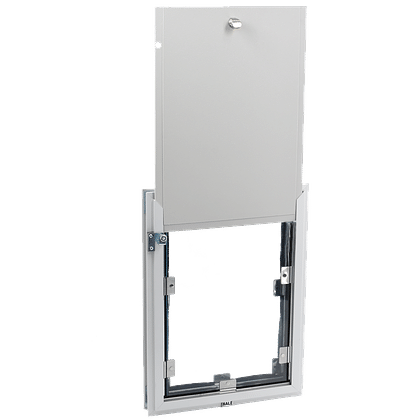 Manual locking cover · no batteries
The collar is the part that fails. We don't use one.
With High Tech Pet, the collar is the key to the whole system, and it lives on a moving animal, exposed to scratching, chewing, water, and play. Its battery needs replacing every few months, and the complaints about it are specific and repeated.
Hale has no collar. That means no transmitter to lose or chew, no battery schedule, and no "my door works but the collar doesn't" failure mode. You lock the door when you want with a simple manual cover.
One owner bought 8 collars and said none lasted more than two days; another loved the door but had bought 8 collars in 4 years. , owner reviews on ConsumerAffairs and Chewy
Lower to start, and covered for life
Both brands are premium, this isn't expensive vs. cheap. But on the door and wall installs most people buy, Hale starts hundreds below the Power Pet line, with custom sizing built into the price.
And the warranty depth isn't close. High Tech Pet's full warranty is one year; after that, the policy explicitly excludes the door's electronic and mechanical guts, with a $100 credit toward a new unit if yours fails. Hale covers the frame for life and the flap on a 10-year prorated basis.
Door & Wall · direct pricing
The cost most pages get wrong
Day-one price is the wrong number to compare
A pet door is a controlled hole in your house. With an electronic door, the real cost is what you feed it for a decade, collars, batteries, and the parts that wear out after year one.
What a Power Pet door costs to keep running
By High Tech Pet's own published prices, the meter doesn't stop on day one. These are the consumables and repair parts that feel optional until real life happens.
An MS-5 collar runs ~$54.99 each, and its proprietary battery (~$14.99 a 2-pack) drains every 3 to 5 months. One pet runs $150–$300 over ten years; two pets, $300–$600.
Once the one-year warranty ends: main board ~$79.99, motor ~$48.99, sensor cable ~$24, AC adapter ~$35.99, backup battery ~$49.99, locking pin ~$10.88. Good they're available. Telling you may need them.
The door needs an outlet nearby (adding one runs ~$150–$350), plus roughly $100–$500 to install a door and $200–$2,000 for a wall, per third-party cost guides.
One soft consumable, not a system to feed
Hale's long-term parts are passive and inexpensive: replacement flaps run ~$36–$204 by size, once in many years, plus a few dollars for weatherstripping or lock parts. There's nothing to charge, no transmitter to replace, and no board that can brick the whole door.
The fair read: with High Tech Pet you're budgeting for appliance maintenance, collars, batteries, sensors, and eventual board or motor repairs. With Hale you're budgeting for an occasional flap. Both are honest costs. They're just different kinds, and one of them is a lot smaller.
Side-by-side
The whole picture, on one screen
Everything below is current and verifiable. On the lines most buyers weigh, simplicity, fit, install options, price, and warranty, Hale comes out ahead (✓). High Tech Pet leads on three niche lines: powered access, no-push opening, and app control.
| Comparison point | |
|
|---|---|---|
| Door type | Mechanical flexible flap, magnetic closure | Electronic, motorized, collar-activated |
| Pet activation | Pet pushes the soft flap | Ultrasonic transmitter collar |
| Power & batteries | ✓None, ever | Collar batteries + optional door battery + outlet |
| App / Wi-Fi | Mechanical by design | Yes, on Wi-Fi and Roll-Up models |
| Selective access | No, mechanical by design | Yes, collar-controlled entry |
| Install types | ✓Door, wall, screen, in-glass, French door, kennel | Door, wall, patio |
| Sizing | ✓11 standard + custom; by shoulder height & chest width | Medium / large (Roll-Up adds XL); mostly by weight |
| Door price (direct) | ✓$216–$699 | $420–$645 |
| Wall price (direct) | ✓$269–$796 | $475–$889 |
| Frame material | 6063-T5 extruded aluminum | ABS composite + polycarbonate panel |
| Locking / security | Manual locking HDPE cover + pin lock | Automatic deadbolt after each pass |
| Full warranty | ✓Lifetime frame + 10-yr prorated flap | 1 year (limited lifetime after, with exclusions) |
| Recurring maintenance | ✓Replace the flap; lifetime frame | Collars, batteries, sensors, motor, board, app/Wi-Fi |
| Return window | 30 days (made-to-order) | 90 days (direct) |
| Shipping speed | 3–12 business days build time first | Often same-day if in stock |
| Made in USA | ✓Yes, built to order since 1985 | Engineered in USA, subcomponents in China, assembled in Ventura |
| Best for | Custom fit, broad installs, long-term simplicity | Selective access, wildlife control, smart-home buyers |
Direct list prices, the most time-sensitive line here. Re-check any current sale price before you order.
What High Tech Pet owners run into
The friction that shows up in their reviews
A good Power Pet door in the right home is a joy, and some owners get many years out of one. But the complaints cluster exactly where the electronics live: collars, batteries, Wi-Fi, and the boards and motors that fail after the warranty ends.
On collars, the most repeated complaint
I bought 8 collars and none lasted more than two days.
ConsumerAffairs
On the boards and motors, after the 1-year warranty
It worked well for about the first year, then the backup battery, motor, and main board all failed over the next two to three years.
Trustpilot
On the Wi-Fi model dropping out
The Wi-Fi stopped after about three months, and the collars let my dogs out but not back in.
Trustpilot
On wanting to stop thinking about it
The door stopped opening after two years. I wanted to replace it with something I could install once and forget.
Chewy
For balance: the PX-1 sits around 4.4/5 from 248 Amazon ratings, with long-term owners reporting many happy years. The pattern is consistent, owners who need automatic access love it, and owners who just wanted a good door tend to feel nickeled-and-dimed by the collars, batteries, and repairs. Hale isn't maintenance-free either, flaps wear and a wall install takes work, but Hale carries a 4.4/5 Trustpilot rating across 482 reviews on build quality, custom fit, and longevity.
Through-wall installs are demanding on any brand. Our wall model ships self-framing, with a pre-wrapped aluminum tunnel, carpet, flashing, raincap, and double flaps in 10″, 16″, or custom lengths, exactly the friction those Power Pet wall reviews describe.
Already own a Power Pet door?
Switching from High Tech Pet?
No reason to replace a door doing its job
If your Power Pet door is solving a real access-control problem and your collars still work, switching to a mechanical door may be a downgrade for that specific need. High Tech Pet sells replacement motors, boards, and panels, so a tired unit can often be repaired.
Look at Hale when the electronics have worn you down, or something is changing: a move, a new install type, a second door, a different pet, or you've decided you'd rather own a door with nothing to charge or program next time.
Swapping over? Don't assume it drops in.
Power Pet cutouts, frame depths, and tunnel designs differ from Hale's, so custom sizing works off real numbers, never an assumption. Before you order:
- Measure your pet, width at the shoulders and the height they can comfortably step over
- Measure the existing cutout, plus the door or wall thickness
- Note the rise, the step-over height your pet clears today
- Note what you have now, a door, wall, or patio Power Pet
- Photograph both sides of the current install
If your pet physically cannot push a flap, be honest with yourself, you may want to stay electronic.
FAQ
Questions shoppers ask comparing the two
? Is Hale a good High Tech Pet alternative?
Yes, and for most homes, the better buy. Hale is the mechanical alternative for people who decided the electronic tradeoff isn't worth it: no collar, no batteries, no motor, no app, plus a custom fit, more install types, a lower starting price, and a lifetime frame warranty. High Tech Pet only pulls ahead if you specifically need motorized, collar-controlled access.
? Does a Hale pet door need a collar or batteries?
No. Your pet uses the door by pushing through a flexible flap. There's no transmitter collar, no microchip, no proprietary battery cycle, and nothing for your pet to wear or lose. That's the whole point of choosing mechanical.
? Does Hale have an app or Wi-Fi like the Power Pet door?
No, and that's deliberate. There's no app, no Wi-Fi, no account, and no firmware, so daily use depends on zero software or connectivity, which is exactly why a lot of people choose Hale. High Tech Pet's Wi-Fi and Roll-Up models do offer app control if that's a feature you truly want.
? Is Hale cheaper than High Tech Pet?
On the installs most people buy, yes. The Hale Door Model runs $216–$699 and the Wall Model $269–$796, both starting below the Power Pet line, and Hale has no collars, batteries, or board repairs to feed over the years. Day-one price aside, the long-term cost gap is wide.
? Will a Hale door keep raccoons and strays out like the Power Pet door does?
Not in the same automatic way, and here's the honest answer. High Tech Pet uses collar activation and an auto-deadbolt to physically exclude any animal without the collar. A Hale door has a lockable security cover, but when your pet has open access through it, it isn't selective. If automatic wildlife exclusion while your pet comes and goes is your top priority, High Tech Pet wins that one.
? Which is better for a timid or arthritic dog?
It depends on the pet. Hale's soft flexible flap is gentle and most trainable pets adapt quickly with a little training. But if your pet flatly cannot or will not push any flap, High Tech Pet's motor opening the panel for them is a genuine quality-of-life win. Be honest about which describes your pet.
? Which is better for large or giant dogs?
For most big dogs, Hale. We size by shoulder height and chest width with custom options up to Giant (15½″ × 27½″), the only reliable way to fit a tall or broad-chested breed. High Tech Pet's Roll-Up XL clears a high weight ceiling, so if you also need electronic control, that's their lane; for the cleanest mechanical fit on an unusual body, Hale.
? Which lasts longer?
A mechanical door has fewer parts that can fail outright, which is its own kind of longevity. Hale backs its frame for life and flaps for 10 years prorated, on an aluminum frame built for the long haul. High Tech Pet has owners reporting many years of service, but a one-year full warranty and repairable electronic parts after that, the boards, motors, and collars that show up in their reviews.
? Can I replace my High Tech Pet door with a Hale door?
Often, but measure first. Existing Power Pet cutouts aren't automatically Hale-compatible. Check the cutout size, your pet's shoulder height and chest width, and the door or wall thickness against Hale's sizing guide before ordering. Send us the numbers and photos and we'll confirm the fit before you buy.
? Is High Tech Pet worth the money?
If you genuinely need what it does, automatic collar-controlled access, app control, or wildlife exclusion, then yes, it can absolutely be worth it. If you just wanted a good pet door, you may be paying for complexity you'll spend years maintaining. That's the real question, and for most homes the answer points to a simpler door.
Find the door that fits your pet
High Tech Pet is smart. Hale is simple. If you need a door that recognizes a collar, opens by motor, and talks to an app, the Power Pet door is built for exactly that. But most homes don't need a motorized appliance in the wall, they need a custom-fit door that just works, with no collars, batteries, or boards. That's Hale.